The Mystery of Marcescence

Copy linkShare to Facebook (opens in new window)X (opens in new window)Share by email
  • _dsc6177-2.jpg
  • December trees at Tims Ford State Park

    Deciduous forest dominates most of Tennessee, so the annual dropping of leaves in autumn is a familiar herald of the season. These leaves provide crucial environmental benefits in the form of moisture retention and nutrient cycling for the soil, as well as critical habitat for a multitude of organisms.

    _dsc6167.jpg

    Abundant leaf litter carpets the ground at Tims Ford State Park

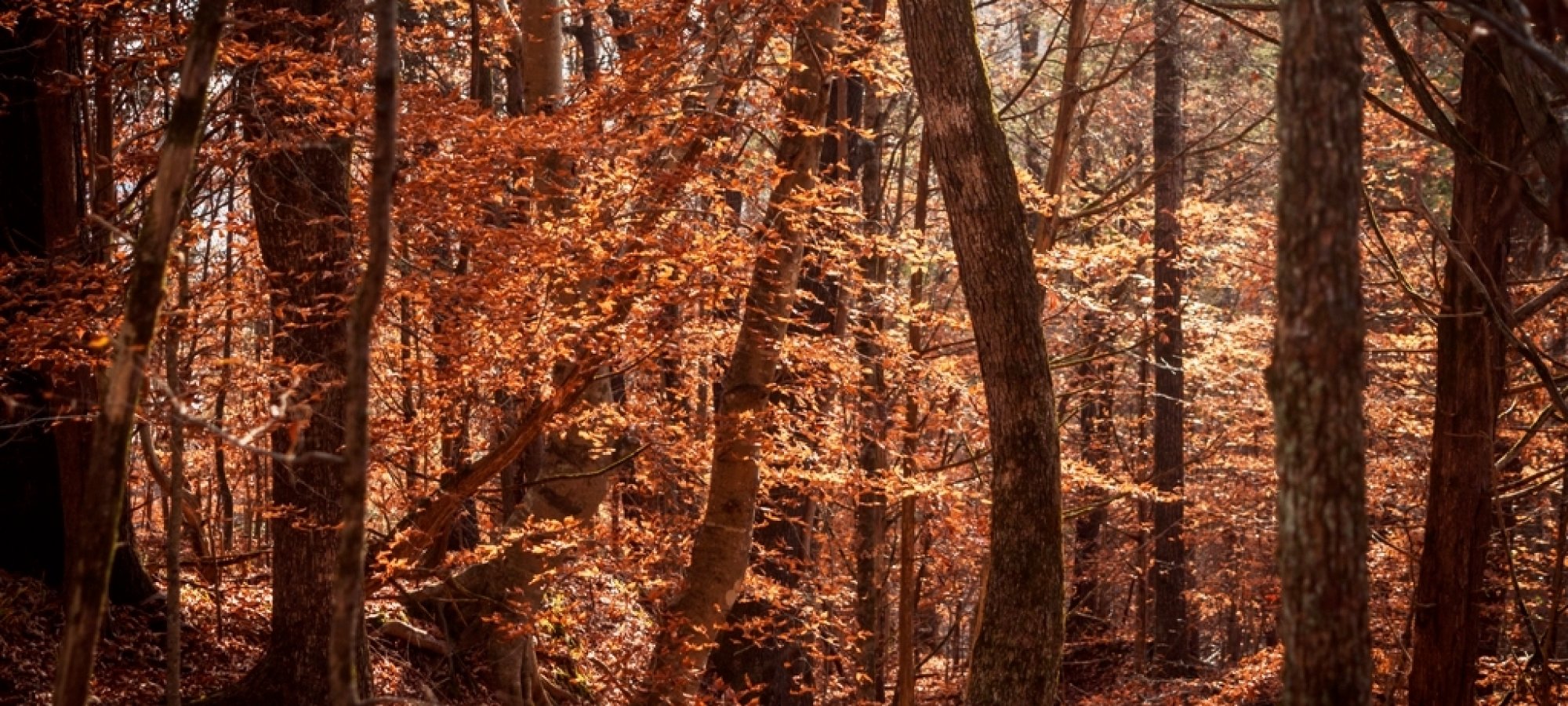
    You may have noticed, however, that not all trees lose their leaves at the same time. If you take a walk through most any forest during the winter months you will spy a handful of these oddball individuals, still sporting foliage among the largely naked trunks and branches. This unusual practice has a scientific term: marcescence - the retention of dead organs by a living plant.

    dscn0603.jpg

    Edgar Evins State Park

    The majority of deciduous tree species drop their leaves in fall, essentially shutting down these photosynthesis factories and detaching them to be re-assimilated into the surrounding landscape. The technical term for shedding leaves is abscission. The tree, and most other woody plants, create an abscission zone at the attachment point where the cells separate, allowing the dead leaf to fall away in autumn. In marcescent trees, this cellular process isn’t activated until the following spring.

    Some common species that practice marcescence are various species of oaks (Quercus), American Beech (Fagus grandifolius), and hornbeams (Ostrya virginica and Carpinus caroliniana). Some of these species are marcescent only in their younger years, and lose this quality into adulthood. Some retain their leaves only up to a certain height, and lose them higher up. Some retain leaves clear up to their canopy, regardless of height, even on trees measuring over 100 feet tall.

    • _dsc6280.jpg
    • _dsc6465.jpg
    • _dsc6224.jpg
    • _dsc4254.jpg

    So we have a pretty good understanding of the how, but what about the why? Scientists are still scratching their heads over this mystery, but they have proposed few ideas….

    The leading theory is related to protection from large browsing mammals. Tender buds on woody foliage are eagerly sought out by ungulates, especially during the colder months when green food is difficult to come by.

    Dead, dry leaves are very unpleasant to consume due to their bitter flavor and lack of nutrition. Crunchy dead leaves also make a lot of noise whenever they are disturbed. You may have noticed this on a quiet winter foray into the woods. The slightest breeze will rustle these dead leaves, piercing the usual silence. A browsing animal can make even more noise, alerting any predators in the area to their presence.

    When we think of large browsing mammals, the only species that really comes to mind is the one we see most frequently: Whitetail Deer. A Whitetail can have as much as a 7 foot reach when it is foraging for woody browse. Yet the dead leaves on marcescent trees typically reach much higher than that. Elk historically roamed throughout the state (and have been reintroduced into a few areas), and the reach of their winter browsing is a foot or two higher. Much further north, moose can be found, but even they have a maximum reach of about 14 feet when browsing, standing on their hind legs and lowering tree branches with their prehensile lips. Yet the average height for clinging dead leaves is around 20 feet on a tree, far beyond the reach of any modern browsing mammal...

    ....but what about extinct ones?

    Not so long ago (about 10,000-12,000 years ago), Tennessee was home to a plethora of mammal species that no longer exist today. Some of these were true giants. Giant Ground Sloths, (Eremotherium) were larger than a modern day elephant, standing 12-13 feet tall with an even higher reach attained by extending their forelegs to forage.

    eremotherium-rusconi-size-738x591.jpg

    Image source: Eremotherium (prehistoric-fauna.com)

    Mastadons stood 10 feet tall at the shoulder, and could reach another 10 thanks to their trunks.

    p018t3fp.jpg

    mage source: BBC Two - Ice Age Giants, In pictures: The ice age giants - American mastodon

    Thus, the biggest of the browsing North American mammals could reach a maximum of about 20 feet to feed on woody browse, which is a tantalizing theory to explain the typical height of marcescence.

    _dsc4287.jpg

    Retained leaves on towering oaks at Paris Landing State Park

    A set of perhaps less romantic hypotheses includes:

    • Trees wish to apply a fresh layer of leaf mulch to their bases in the spring, when most other leaf litter has already decomposed.
    • The leaves trap moisture which helps prevent desiccation of developing buds
    • Retained leaves provide cover for small animals which in turn deposit fertilizer at the base
    dscn1192.jpg

    As is often the case with nature, it is highly possible that there isn’t only one benefit to this practice, but many or all of them at once.

    A good winter read that I highly recommend is The Nature of Oaks: The Rich Ecology of Our Most Essential Native Trees by Douglas W. Tallamy. He explores this mystery as well as many other fascinating characteristics of oaks.

    3370_4321_large.jpg

    Source: The Nature of Oaks: The Rich Ecology of Our Most Essential Native Trees: Tallamy, Douglas W.: 9781643260440: Amazon.com: Books

    Whatever the reason for this phenomenon, we can all agree that marcescence provides visual and even auditory interest in the bare, quiet winter woods...

    _dsc6189.jpg

    ... and it's also fun to imagine a mastodon munching on a tree as you pass by.

    Holly Taylor headshot

    Holly Taylor

    Related Articles

      “A Wonderful Bird is the Pelican…”

      We often associate pelicans with sea spray, waves and warm beaches, yet one of America’s largest and most majestic birds breeds in the American Heartland and can be seen during its winter migration on inland freshwater and coastal bays and estuaries throughout our continent.
      “A Wonderful Bird is the Pelican…” - Read Article

      Honor Black History at Tennessee State Parks

      During Black History Month this February—and throughout the year—we invite you to reflect on Black history in Tennessee's state parks. Explore these parks that preserve and share Black history and heritage.
      Honor Black History at Tennessee State Parks - Read Article

      African American History at Booker T. Washington State Park

      As we celebrate African American history throughout the month of February, we also recognize the ties to our cultural heritage. Shared and equitable access to our parks is directly tied to our mission to preserve our natural landscape and the history behind it. T. O. Fuller State Park and Booker T. Washington State Park** are two parks in Tennessee that were established for the state’s African American population in an age when segregation barred equal access to the landscape. In this blog, we're reviewing the history of Booker T. Washington State Park.
      African American History at Booker T. Washington State Park - Read Article