
Rain Crows and Caterpillars

Copy linkShare to Facebook (opens in new window)X (opens in new window)Share by email
Rain Crow and Caterpillars

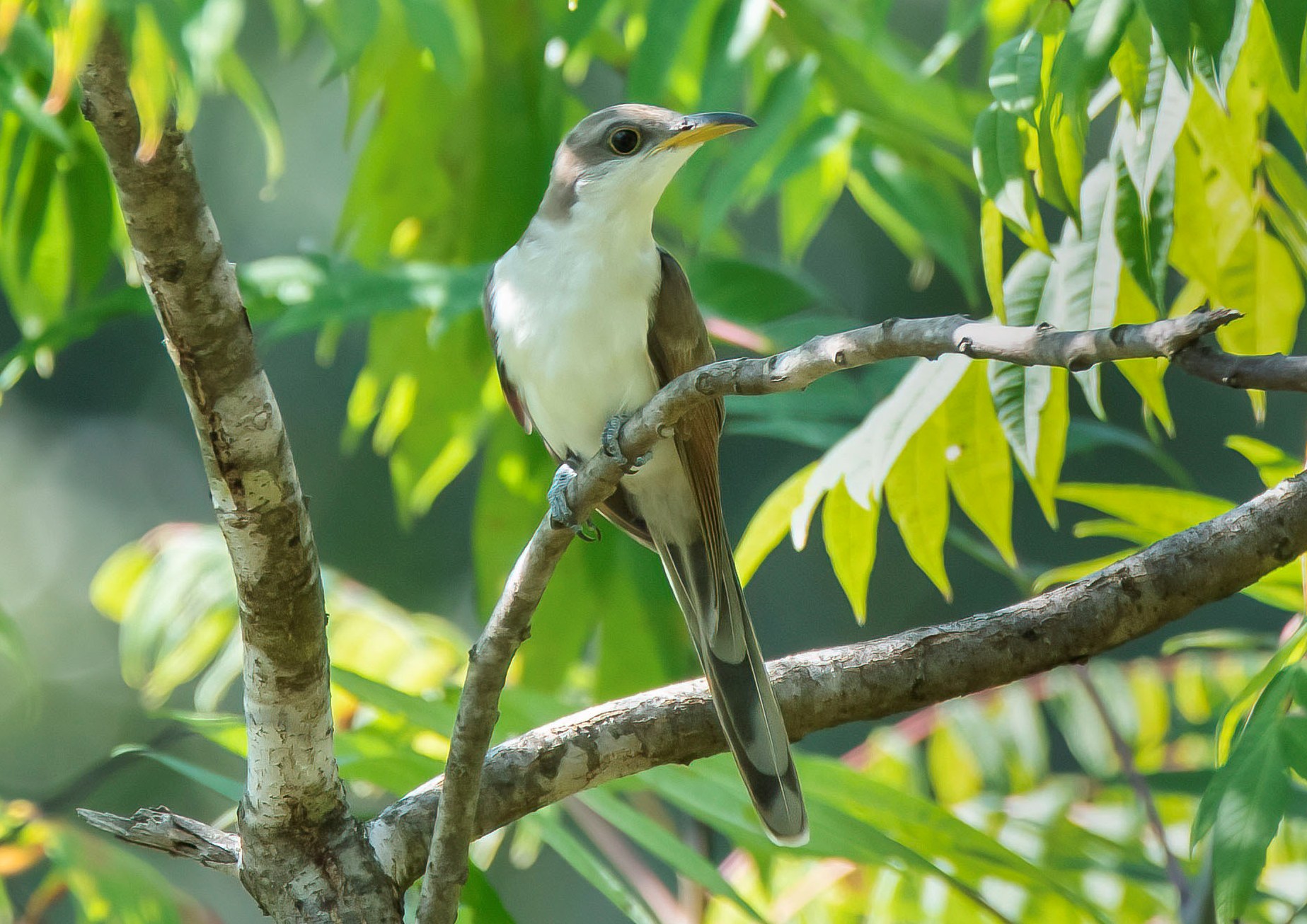
Yellow-billed Cuckoo (photo courtesy Jim Williams)

When my mother was young and newly married she was an avid birder. One day she was outside with her father-in-law when a distinctive, exotic call echoed through the trees. My mother confidently informed my grandfather that what they heard was a Yellow-billed Cuckoo. He looked at her and laughed saying,"You silly girl, that's a Rain Crow!"

Out of the 420 or so bird species that live, breed or migrate through Tennessee, it is difficult to pick a favorite. But there is something about these shy skulkers with their charismatic calls and adventurous eating habits that never ceases to fascinate me.

The Yellow-billed Cuckoo is a bird that migrates to Tennessee to breed. One of the later arrivals, they typically do not start showing up until late April or early May. Larger than a robin and smaller than a crow, they are shy birds that move silently and stealthily through the woody vegetation.

_dsc4947.jpg

A Yellow-billed Cuckoo peeking out from the vegetation. Note the mostly yellow, downcurved bill. (photo courtesy Ranger Mark Taylor)

They have been documented in most of our State Parks and Natural Areas, and if you happen to get a look at one you will see a long, sleek bird that is warm brown above and pale below with reddish wingtips.

ybcu_jim_williams.jpg

Yellow-billed Cuckoo showing its reddish wingtips (photo courtesy Jim Williams)

They have a long, mostly yellow bill that is downcurved, and underneath their tail sports 6 large white spots that contrast sharply on a black background.

dscn7872.jpg

A Yellow-billed Cuckoo giving a nice view of the large, white spots its tail underside

You can often spot them by their distinctive silhouette as they fly overhead. Their wings are long and pointed, and their long tails are typically held together as they fly. Cuckoos are more often seen than heard, however. They have two distinctive calls that ring out through the forest on warm days.

One of their vocalizations to listen for is a soft, repeated cooing. Both sexes make these sounds, typically during courtship. Their louder call can be described as a hollow, knocking call:  ka-ka-ka-ka-ka-kow-kow-kowlp-kowlp-kowlp-kowlp!  (You can listen to it here.) It has such an exotic sound to it that it nearly transports you to some distant rainforest, especially since they tend to call more frequently during the hot, humid summer months. As a long-distance migrant they do indeed spend their winters in the tropical and semi-tropical regions of South America.

_dsc7068.jpg

A Yellow-billed Cuckoo hopping into the open for a rare good look. (Photo courtesy Ranger Mark Taylor)

Their preferred habitat is mixed deciduous forest with a thick canopy, especially near water. They will also inhabit areas with a scrubby understory, overgrown orchards, abandoned farmland and dense thickets along waterways. They spend most of their time in thick, woody vegetation, but every once in awhile will fly to the ground to catch insects.

dscn0239.jpg

Yellow-billed Cuckoo grabbing a Tent Caterpillar on the ground at Red Clay State Park. (Photo courtesy Interpretive Ranger Taylor Young)

If you thought the Yellow-billed Cuckoo was cryptic and difficult to observe, wait until you hear about the Black-billed Cuckoo!

_dsc8951.jpg

Note the red eyering on the elusive Black-billed Cuckoo. (Photo courtesy Ranger Mark Taylor)

A rather sporadic breeder in our state, they are more frequently observed during migration. How do you tell them apart? While similar in size and shape to a Yellow-billed, they tend to sit with a more hunched posture. As their name suggests, they have a bill that is solid black. Adults also have a red eyering and less defined white markings on the undersides of their tails. Of course, this information is only helpful if you can manage to spot one of these super secretive birds!

dscn7976.jpg

An immature Black-billed that gave the author a rare good look in her own backyard! Young birds lack some of the defining features of the adults, but always have an all-black bill.

Luckily, their calls are also different from the Yellow-billed. They belt out a more subtle and rapid series of cu-cu-cu-cu's over the course of several minutes. (Listen here.)

The name cuckoo tends to remind people of another bird in their family, the Common Cuckoo. This species lives in Europe, Africa and Asia, and is known as a notorious nest parasite. While the Yellow-billed and Black-billed will occasionally partake in the practice of laying eggs in the nests of other birds, they are far more likely to raise their own chicks than their Old World counterparts. 

What of their common folk name? They are frequently hailed as Rain Crows (or Storm Crows), due to the long-held belief that their appearance or loud calls foretell a summer storm. They have also been observed calling in response to claps of thunder. In spite of this, there is no scientific data to back up this Old Wives Tale, and the timing of their calls has more to do with coincidence and the frequency of summer storms than it does actual weather forecasting. Still, the name Rain Crow persists throughout the South and Midwest. 

Like so many of the birds that raise their babies in Tennessee, cuckoos feast on caterpillars. Caterpillars provide the best nutrition for growing birds tucked into a ready-to-eat package.

dscn3345.jpg

Eastern Phoebes, like most birds, prefer smooth-bodied caterpillars to feed their young.

Not surprisingly, caterpillars would prefer not to be eaten, so they have come up with a plethora of clever strategies to avoid predation. Camouflage, mimickry, distasteful or toxic chemicals or even sounds are used to avoid getting gulped by a bird. Some of these larvae are covered in dense, irritating hairs, or sharp, stinging spines.

dscn7869.jpg

This cuckoo is rolling a caterpillar in its bill to remove some of the irritating hairs before eating

Most birds, however, tend to avoid caterpillars that fall into this latter category, preferring those that are smooth-bodied. Not cuckoos! They specialize in the catepillars that many other birds will turn their beaks up at - including the stinging ones!

dscn8083.jpg

They have the ability to collect caterpillar spines in the lining of their stomachs, and occasionally shed and regurgitate this lining, much like an owl coughs up a pellet. Even the most formidable stinging species such as the Saddleback (aka Pack Saddle) or Buck Moth don't deter these voracious caterpillar hunters.

dscn7876.jpg

This Yellow-billed Cuckoo is about to gulp down a Saddleback Caterpillar (Acharia stimulea). Now that's a spicy meal!

They also like to feast on colonial web-making moth caterpillars, such as the Eastern Tent Caterpillar (Malacosoma americana) or Fall Webworm (Hyphantria cunea). Both of these are easy to spot, and many humans find their feeding habits to be an eyesore or even a threat to the trees they take up residence in.

dscn2386.jpg

Eastern Tent Caterpillars can be observed throughout spring and early summer. They make distinctive tent-shaped webs in the cruxes of branches.

It is rare that these caterpillars exact any lasting damage on these trees, and they are especially enjoyed by cuckoos. In fact, they have been recorded eating as many as 100 tent caterpillars in one sitting! Even the silk from these web-making caterpillars is gathered by birds for nesting material.

dscn6057.jpg

Fall Webworms feed on a diversity of trees and shrubs. Their webs are made on the ends of branches.

In mid-late summer large numbers of furry caterpillars in the genus Datana emerge to feed on a diversity of trees. These are also eagerly sought out by hungry cuckoos.

img_20230806_131425.jpg

A large colony of Walnut Caterpillars (Datana integerrima) can look a bit alarming, but they pose no threat to humans.

It is these large seasonal explosions of caterpillars and other insects that have drawn generation upon generation of cuckoos to leave the more tropical areas in favor of the temperate United States. This historical seasonal abundance has triggered migration for many species, and gives us the chance to see a dazzling array of breeding birds in the warmer months. 

Like far too many of our migrating breeding birds, however, cuckoos are in steep decline across their range. In the Western United States Yellow-billed Cuckoos are candidates for the Endangered Species List. In our region they are considered threatened, declining at an annual rate of about 0.8%. Black-billed Cuckoos don't appear to be faring much better. They are currently on the watch list making them a species of high conservation concern. If their numbers continue to drop at the current rate, their population will be halved by 2037.

dscn7975.jpg

The biggest threat to both of these species is habitat loss, both in their breeding and wintering ranges. In addition, our decline in birds mirrors a worldwide decline in insects. Cuckoos in particular are dependent on large "outbreaks" of caterpillars that are often considered pests by landowners. Removing these larvae through chemicals or other means eliminates a vital food source from the landscape. The populations of cuckoos fluctuate in rythm with normal annual cycles of boom and bust with these insect larvae, but a continued loss of this food source will cause their numbers to keep falling as the years go on.

_dsc4928-2.jpg

(Photo courtesy Ranger Mark Taylor)

While we often think of landscaping our yards and businesses strictly from an aesthetic or economic point of view, it is crucial to the future of our local ecosystems to use a different approach - one that cultivates these native insect populations. Growing plants for the purpose of attracting insects can seem like a pretty radical viewpoint given our culture's overriding negative perception of "bugs." We should, however, garden as if life depends on it - because it truly does! By choosing native plants to adorn our backyards and abstaining from pesticides, we are promoting a landscape that grows and sustains life. 

dscn3692.jpg

Our Rain Crows will soon be leaving Tennessee and returning to their haunts south of the equator. Late September and early October is a great time to watch the trees for these birds as they hunt non-stop for caterpillars to fuel their long southward journeys. I imagine people living in South American countries are now eagerly awaiting the arrival of the cuckoos to their wintering grounds so they can enjoy their hunting antics. Nature is never static. Living more intune with its annual rythms offers a great sense of peace and joyful anticipation - a state we are meant to exist in year-round.

As one more summer draws to a close, listen for the Rain Crows heralding the next thunderstorm. Let's ensure they can continue to announce summer rains for the generations yet to come.

_dsc8494.jpg

Black-billed Cuckoo (photo courtesy Ranger Mark Taylor)

Holly Taylor headshot

Holly Taylor

Related Articles

    “A Wonderful Bird is the Pelican…”

    We often associate pelicans with sea spray, waves and warm beaches, yet one of America’s largest and most majestic birds breeds in the American Heartland and can be seen during its winter migration on inland freshwater and coastal bays and estuaries throughout our continent.
    “A Wonderful Bird is the Pelican…” - Read Article

    A Year in Birds at TN State Parks

    In Tennessee, at least 423 species have been recorded since 1900, and most of them have been viewed in one of our state parks at one time or another.
    A Year in Birds at TN State Parks - Read Article

    Parks Planting for Pollinators

    Learn how state parks are restoring pollinator-friendly spaces and encourages individuals to help by supporting native plants and conservation efforts.
    Parks Planting for Pollinators - Read Article