Rocky Fork Highlights
Lamar Alexander Rocky Fork State Park
Named for Senator Lamar Alexander in 2019, the Lamar Alexander Rocky Fork State Park covers over 2,000 acres of scenic wilderness in Unicoi County in the southern Appalachian Mountains of East Tennessee. The park is surrounded on three sides by the Cherokee National Forest with steep, rugged terrain that drains into cool mountain streams such as Rocky Fork Creek. The Rocky Fork Watershed has large moss-covered boulders, deep pools, and eddies that enhance the miles of excellent native trout fishing.
Discover Rocky Fork State Park
Rocky Fork State Park, nestled in the heart of the Blue Ridge Mountains, is a remote backcountry park tasked to preserve the watershed and the natural and cultural resources that it provides. Visitors who come to Rocky Fork State Park can expect to experience nature in its truest form.

History
The story of land comprising Rocky Fork State Park starts with pre-Cherokee tribes, including those from the late archaic and middle woodland periods, who used this area as hunting grounds, leaving behind traces of their presence.
The park contains a noted cultural site at the junction of Flint Creek and Rocky Fork Creek. This location was the winter encampment of Creek and Cherokee Indians in the late 1700s when Colonel (and later Governor) John Sevier and his troops surrounded the encampment, making a surprise attack in response to long-standing tension between the two groups. The Creek and Cherokee sustained heavy fatalities and casualties during the conflict.
The land has been used for mining precious metals such as iron, zinc, lead, and manganese, as well as clay pottery factories. At the turn of the 20th Century, timber harvesting was a major use of this area. Even before becoming a state park, the land was also used for recreational hunting, fishing, and horseback riding.
Acquisition of the parkland was made possible with the cooperation and dedication of several government and non-profit groups, including the U.S. Forest Service, the Tennessee Department of Environment and Conservation, the Heritage Conservation Fund, The Conservation Fund, the Appalachian Trail Conservancy, and the Southern Appalachian Highlands Conservancy. Part of the Rocky Fork watershed was designated a Tennessee State Park and named Rocky Fork State Park in October 2012, but didn’t officially open until 2015. In January 2019, Rocky Fork State Park was renamed Lamar Alexander Rocky Fork State Park.
From the Rangers
-
The Perfect Day
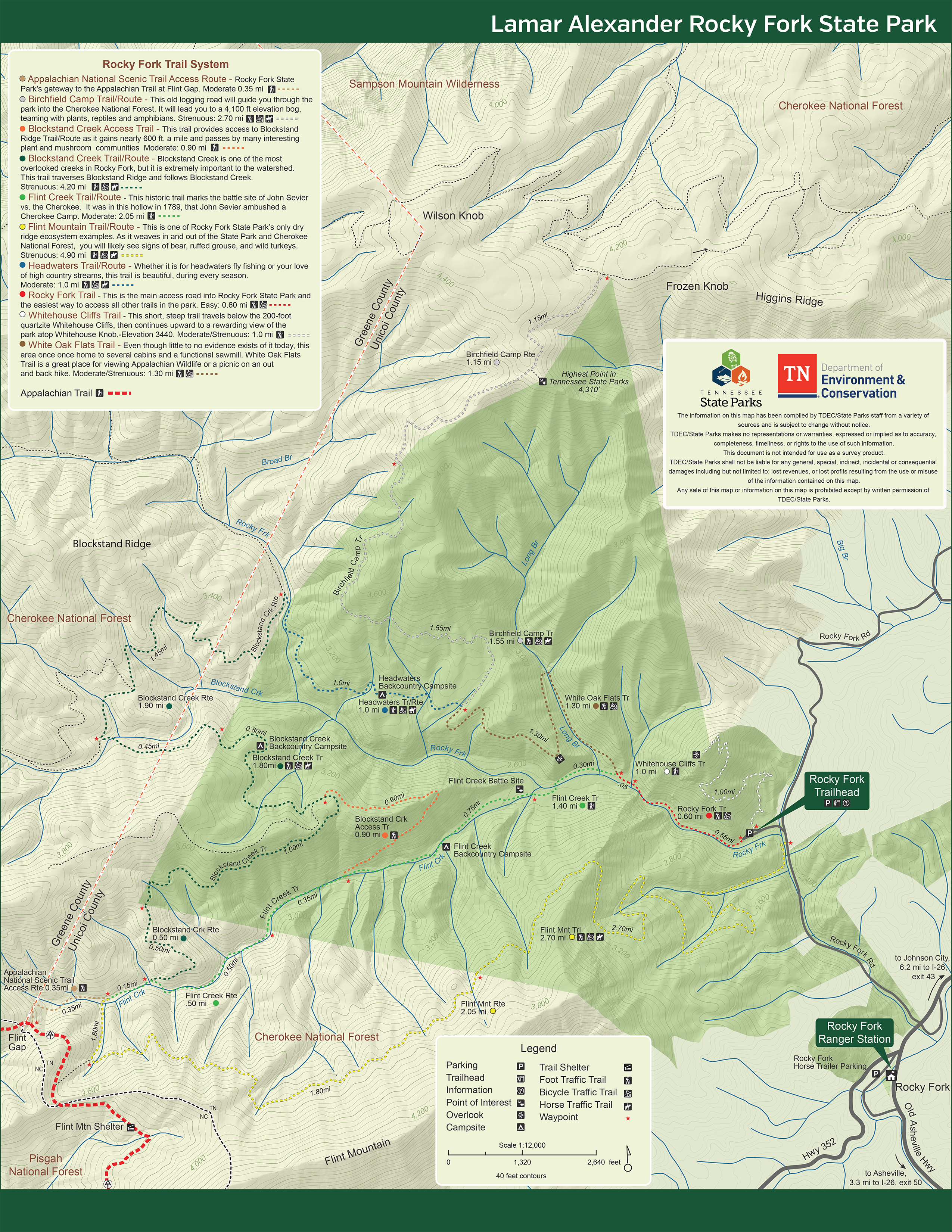
At 3,340’ elevation, Whitehouse Cliffs Knob offers a nearly 360-degree scenic view of the Rocky Fork Watershed, Sam’s Gap, Big Bald Mountain, and other surrounding mountain ranges. This one-mile hike will challenge anyone as you gain 1,000’ elevation from the parking lot to the summit.
-
Insider Information
Full Moon and New Moon Hikes are unique experiences, seeing the high population of salamanders and Brook Trout. All of these can be found at Rocky Fork State Park.
-
Know Before You Go
Rocky Fork Road is a one-lane county road with various tight turns, blind corners, and two bridges. Horse trailer parking is located in the parking lot across the creek from the Park Ranger Station.


Trails
The park offers three identified trails in the main area of the park: Raptor Ridge (moderate difficulty), Wetland Loop (easy difficulty), and the All-Access Trail (easy difficulty). There is also a trail at Camp Hazlewood (moderate difficulty).
-
Mountains and Vistas
Rocky Fork is nestled within the Bald Mountain Range (Blue Ridge Mountains), offering breathtaking mountain views from several vantage points. At 3,340' elevation, Whitehouse Cliffs Knob, provides a nearly 360-degree scenic view of the Rocky Fork watershed, Sam's Gap, Big Bald Mountain, and other surrounding mountain ranges. Whiteoak Flats Overlook offers visitors a view of Whitehouse Cliffs and Blackstack Cliffs, shadowed by Big Bald Mountain in the background.
-
Cascades and Falls
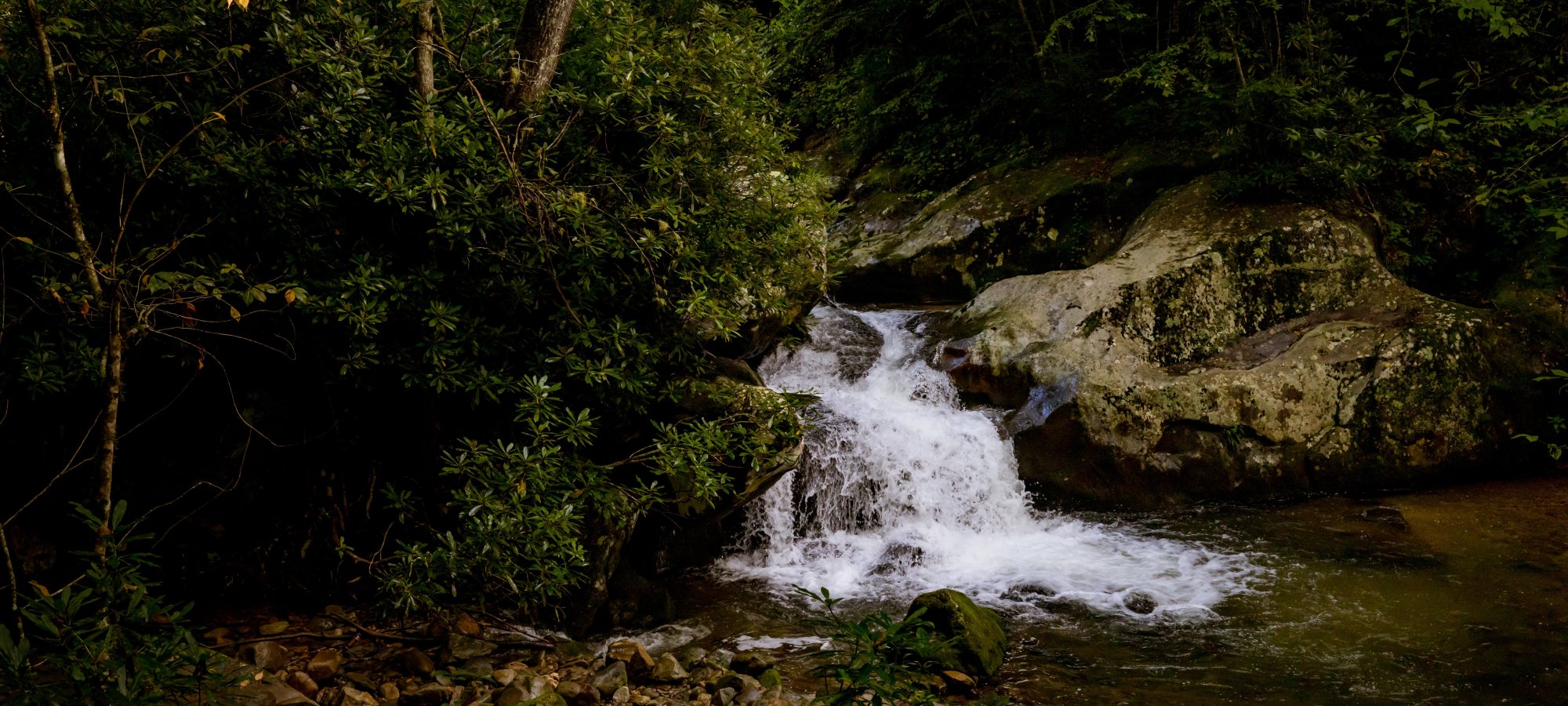
There are hundreds of cascades and falls located throughout the park. Rocky Fork and the tributary branches that feed into the watershed all travel from high elevation peaks through the Rocky Fork gorge and on to the Nolichucky River. Rocky Fork Trail and Rocky Fork Road are two great places to see cascades and waterfalls at our park. Rocky Fork can be kayaked during high water by experienced whitewater kayakers and has been rated as a class 5 creek.
-
Ridges
Ridges in Rocky Fork State Park vary depending on location, but generally, visitors can expect to experience a dry ridge-heath bald climate on our ridge. It is common to see a higher population of mountain laurels and rhododendrons as well as table mountain pines and even American chestnuts. Ridges are the best places to find signs of bear movement as the tend to travel along ridges. Should you encounter a bear, keep your distance and back away slowly. Never run away from or turn your back on a bear. Never attempt to feed a bear. Approaching, disturbing, or displacing a bear is illegal.
-
Wetlands, Ponds and Springs
Adjacent to our parking area, you will find a spring-fed bog. In some of the higher elevations, you will find heath bogs. Throughout the park, you will find numerous bold springs. Be careful where you walk and be aware of your surrounding areas as you explore Rocky Fork State Park. A pond is located near the confluence of Rocky Fork and Flint Creek. The story is told that it was originally created to allow locals with mobility issues to have access to fishing.
-
Creeks and Pools
Our creeks can be described as cold, clear, and freestone. Swimming and wading are allowed in Rocky Fork Creek and Flint Creek. We also have Long Branch Creek, Blockstand Creek, and South Indian Creek. The Blue Hole is a great swimming hole located above a waterfall. It is located along Rocky Fork Road. There are several other swimming holes located adjacent to cascades. Note there is a risk of hypothermia even in the summer. Water temperature in the summer averages in the 60s.
-
Waterfalls
There are numerous small falls throughout Rocky Fork State Park.
- Firefly Falls
- Tims Falls
- Rocky Fork Falls 10’
- Long Branch Falls 15’
- Aretha Falls
- Lower Higgins Creek Falls
- Buckeye Falls


Plants
Rocky Fork State Park is home to a wide variety of wildflowers that begin blooming in early April and continue into late Fall.
Native wildflowers find ideal growing conditions and include pink lady’s slipper, yellow fringed orchid, and lesser purple fringed orchid, plus several native lilies, including Turk’s cap and Michaux’s lily. Diverse and varied fungi thrive in Rocky Fork’s cool, damp climate.
As you ascend in elevation, you'll notice a shift in plant life, with high-elevation wildflowers like flame azaleas appearing higher up. Be sure to ask a Park Ranger about the unique plants that thrive in this area.

Plant Types
- American Chestnut
- Flame Azaleas
- Fungi (Variety)
- Hemlock
- Lesser Purple Fringed Orchid
- Lilies (Native)
- Michaux’s Lily
- Mountain Laurel
- Pink Lady’s Slipper
- Rhododendrons
- Turk’s Cap
- Yellow Fringed Orchid
Landscaping Guides

Birds
Rocky Fork State Park has a rich environment for many varieties of birds such as cormorants, hawks, swallows, crows, warblers, and tanagers.
Due the density and variety of hardwoods and other trees, we have a large variety of woodpeckers.
Bird Species
- Acadian Flycatcher
- American Crow
- American Goldfinch
- American Robin
- American Woodcock
- Bald Eagle
- Barn Swallow
- Barred Owl
- Belted Kingfisher
- Black-and-White Warbler
- Black-throated Blue Warbler
- Black-throated Green Warbler
- Black Vulture
- Blue-headed Vireo
- Blue Jay
- Blue-winged Teal
- Broad-winged Hawk
- Brown Creeper
- Canada Warbler
- Carolina Chickadee
- Carolina Wren
- Cedar Waxwing
- Chestnut-sided Warbler
- Chimney Swift
- Common Grackle
- Common Raven
- Cooper’s Hawk
- Dark-eyed Junco
- Double-Crested Cormorant
- Downy Woodpecker
- Eastern Phoebe
- Eastern Towhee
- Eastern Wood-Pewee
- European Starling
- Evening Grosbeak
- Golden-crowned Kinglet
- Gray Catbird
- Great Crested Flycatcher
- Hairy Woodpecker
- Hooded Warbler
- Indigo Bunting
- Killdeer
- Louisiana Waterthrush
- Mourning Dove
- Northern Cardinal
- Northern Flicker
- Northern Mockingbird
- Northern Parula
- Northern Saw-Whet Owl
- Osprey
- Ovenbird
- Peregrin Falcon
- Pileated Woodpecker
- Pine Siskin
- Pine Warbler
- Purple Martin
- Red-bellied Woodpecker
- Red-breasted Nuthatch
- Red-tailed Hawk
- Rock Pidgeon
- Rose-breasted Grosbeak
- Ruby-crowned Kinglet
- Ruby-throated Hummingbird
- Ruffed Grouse
- Scarlet Tanager
- Sharp-shinned Hawk
- Song Sparrow
- Spotted Sandpiper
- Tufted Titmouse
- Turkey Vulture
- Veery
- White-throated Sparrow
- Wild Turkey
- Winter Wren
- Wood Duck
- Wood Thrush
- Worm-eating Warbler
- Yellow-bellied Sapsucker
Animals
Many animals call the park home.
The lush forest supports numerous federally listed species, including the Yonahlossee salamander, the woodland jumping mouse, and the world’s fastest flyer, the peregrine falcon. The park is part of the Unicoi Bear Reserve because black bears make their home here. If you encounter a bear, it is imperative that you keep your distance. Getting too close to a bear can cause it to become aggressive. Slowly back away from the bear. Never turn your back on a bear or run away from it.

Animal Species
- Black Bear
- Brook Trout
- Nashville Crayfish (Endangered)
- Fireflies
- Rainbow Trout
- Salamanders
- Snakes
Inspiration
-

Wonderful Winter Hikes in Tennessee
Wonderful Winter Hikes in Tennessee - Read ArticleWinter is one of the best times to hike at Tennessee State Parks, with quiet trails, fewer bugs, clear views, and dramatic landscapes of icicles and fresh snow. -
Tennessee State Park Road Trips
Tennessee State Park Road Trips - Read ArticleRoad Trips are great because they’re flexible. We pre-planned five road trips packed with Tennessee State Parks, incredible outdoor adventures, history, and overnight stays. -

A Year in Birds at TN State Parks
A Year in Birds at TN State Parks - Read ArticleIn Tennessee, at least 423 species have been recorded since 1900, and most of them have been viewed in one of our state parks at one time or another. -
Unique Ways to Experience Fall Foliage in Tennessee
Unique Ways to Experience Fall Foliage in Tennessee - Read ArticleAs leaves change color and crisp air settles in, it's the perfect time to explore Tennessee's natural beauty. With over 60 state parks, you'll find countless opportunities to witness autumn's vibrant hues. Here are some unique suggestions for viewing fall foliage—including what to do and where to visit.